.png)
Elevating the Dining Experience: The Power of Collaborative Robot Service
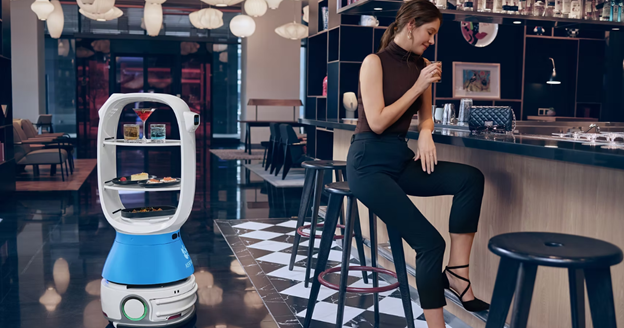
Restaurants are adopting automation to secure both efficiency and service in an environment where customer expectations are high and staffing problems are still there. The transformation in the automation industry is gradual but powerful with innovations in hospitality robots.
Why the Dining Floor Needs Reinvention
Today, modern dining service providers are facing basically three problems:
1. The cost of labor is high
2. The availability of staff is not reliable
3. Customers are expecting perfect service with personal touch
So, the smart dining service operators are not only replacing people with technology but also integrating both to enhance the service quality. And this is the core mission of HelloGard, which supports teams with AI robots that provide better guest experiences with efficiency.
The Rise of Hospitality Robots in Restaurants
Hospitality robots refers to machines that are specially built for guest-facing services and support roles in hotels, restaurants, and resorts. These robots handle the repetitive and nonvaluable tasks and keep the human staff free from these types of works. Thus, the human staff can easily focus on connection, upselling, and guest delight.
These are some key benefits of hospitality robots:
Robots can transport dishes from the kitchen to the table, enabling servers to interact with guests more while clearing the floor.
They are always performing at the same level, do not need breaks or training cycles, and can be scheduled for long work hours.
If they are correctly integrated, they become a team member, enhancing the human touch, not replacing it.
How Restaurant Robots Transform Services
The integration of restaurant robots usually involves multiple units that work with proper coordination, such as serving plates, taking away used dishes, refilling beverages, and even directing guests.
These key improvements can be visible in the workflow due to restaurant robots:
Continuous delivery: Robots ensure that the orders are constantly moving from kitchen to table, thereby reducing the waiting time.
Task specialization: Some robots get assigned to clearing tables or bussing, while the human staff attend to the guests.
Simultaneous service: Multi-robot systems enable the serving of several tables in a unified manner, and no diner is left waiting while others are being served.
Improved turnover: The faster clearing and service ensure more seats served per shift without guests feeling rushed.
The Role of AI Robot Platforms
The AI robots bring together intelligence, coordination, and adaptation to the robotic service ecosystem. Some of the main features of AI robots that enhance the dining experience.
Navigation and obstacle avoidance in real-time through LiDAR and vision sensors.
The robots communicate with each other to avoid bumping into other obstacles and staff. Through this method they distribute tasks with each other efficiently.
Integration with POS (Point of Sale) and kitchen systems enhances the workflow because delivery robots take the orders, plan the best routes, track their work, and send data back to the management.
Managers can track how many deliveries were done, how fast tables were turned, and which servers had the longest guest-interaction time.
Real‑World Impact of Collaborative Robot Service
Restaurants that implement multi-robot strategies can find a lot of measurable benefits:
Faster dish delivery and table reset times.
Less time spent by staff for walking between the kitchen and dining room.
Staff spends more time at the guest table.
Better guest satisfaction due to quick and smooth service interaction.
Increased capacity for effective seating by improving turnover without compromising guest experience.
Case Study: Keenon W3 in a Busy Upscale Bistro
Restaurant Overview
An upscale 70-seat bistro in an urban dining district deployed two Keenan W3 robots during a seasonal hiring gap.
Challenges
Server turnover was 30% in 60 days.
Guest wait times averaged 14 minutes during peak hours.
Servers walked 3.5+ miles per shift, which reduced upsell energy.
HelloGard Solution
Two Keenon W3 robots were deployed for:
Main course delivery (from kitchen to table)
Table clearing (returning used dishes to the washing area)
Scheduled support during lunch and dinner rush hours
Results After 90 Days:
Metric | Before | After W3 Deployment |
Avg. Guest Wait Time | 14 mins | 8 mins |
Server Walking Distance | 3.5 miles | 1.8 miles |
Table Turnover Rate | 1.7/hour | 2.6/hour |
Guest Satisfaction | 86% | 95% |
Bonus Insight:
Revenue per cover at the bistro increased by 4%, thanks to the staff's increased focus on personalized service and upselling.
How to Deploy These Robot Services Perfectly
To enhance the service quality with modern robotics technology, the proper deployment of these AI robots is necessary. So, you should follow these:
First of all, find your biggest obstacle. If the washing of dishes takes too long, then start with automated delivery robots, and if table clearing is taking time, then go for automatic bussing robots.
Ensure the integration of robots with already existing human workflows. Robots should support your staff and help to avoid extra burden.
Monitor ROI by tracking labor hours saved, guest satisfaction, and table turnover before and after the automation.
Maintain a human‑centric narrative because guests still value human servers. Robots should make human service better, not feel cold or non-human.
Why Helogard is Ready to Move Forward
HelloGard provides intelligent robotic services to human-centered industries, such as restaurants and hospitality. The combination of autonomous service robots and powerful management software makes dining operations grow without losing customer engagement.
Our flexible models and emphasis on real-time ROI help restaurants with the deployment of restaurant robots that are suitable for their brand and service style.
Conclusion
The use of collaborative robot service in dining is not only about novelty but also about enhancing the whole guest experience up to a new level. With hospitality robots hotels and restaurants can work seamlessly to make the operations smoother while enhancing the human connection.
HelloGard is excited to help restaurants and hotels that want to make a confident and successful transition to this new service paradigm. Let's connect and talk about how automation can benefit the dining floor of your restaurant or hotel.


Comments